
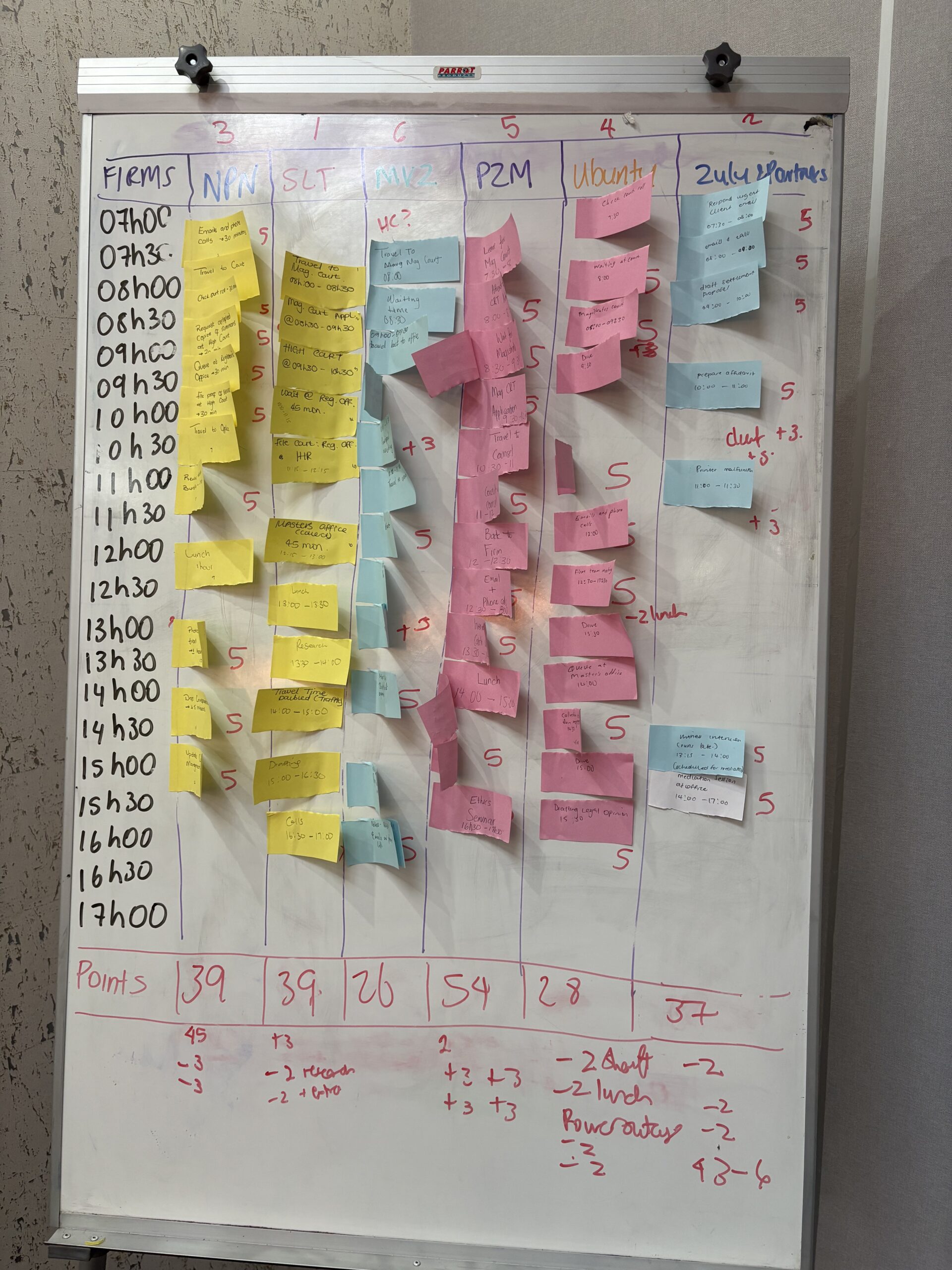
The real learning was not about packing more into a day. It was about reassessing priorities, adjusting expectations, and responding thoughtfully when plans change.
There is a particular kind of irony in preparing a time management training session and having your computer fail to sync to iCloud, twice. Once the night before, and once again during preparation on the day. Both times, I had to recreate content from scratch.
It was, as it turned out, the perfect warm-up. Because the session that followed was entirely about exactly that: what happens when the plan does not survive contact with reality.
The exercise
Students were given a list of realistic practice-based tasks and asked to plan a full working day as a candidate attorney. Diary slots were allocated. Priorities were set. Tasks were neatly arranged across the hours of the day. The sticky-note diaries looked satisfyingly organised.
Then I introduced the curveballs. The court file is missing. The client is late. The printer is broken.
These are not exceptional events. They are Tuesday. Any practising attorney will recognise them instantly, the small disruptions that arrive without warning and demand an immediate response, regardless of what else is already on the diary.
What the exercise was really about
The point of the exercise was never about fitting more tasks into a day. It was about what happens when the neatly planned day meets the messy reality of practice. How do you reassess priorities under pressure? How do you manage a client’s expectations when something outside your control has gone wrong? How do you stay professional and composed when everything is slightly on fire?
These are not skills that come from a textbook. They come from experience, reflection, and the deliberate practice of thinking clearly when things do not go to plan.
The skill nobody talks about enough
Legal training equips attorneys with knowledge of the law, drafting skills, and procedural know-how. What it does not always teach explicitly is adaptability, the ability to absorb disruption, recalibrate quickly, and keep moving forward without losing professionalism or perspective.
Legal practice rarely unfolds neatly. Clients are unpredictable. Courts are unpredictable. Technology, as I was reminded in the hours before this very session, is particularly unpredictable. The attorneys who thrive are not necessarily the ones with the most perfectly organised diaries. They are the ones who know what to do when the diary falls apart.
Developing that ability, to adapt without losing perspective or professionalism, may be one of the most important things we can teach. And sometimes, the best way to teach it is to introduce the curveball and see what happens next.
Interested in skills development training for your legal team? We offer practical, practice-based training for candidate attorneys and legal teams.
This article is for information purposes only and does not constitute legal advice.

0 Comments