
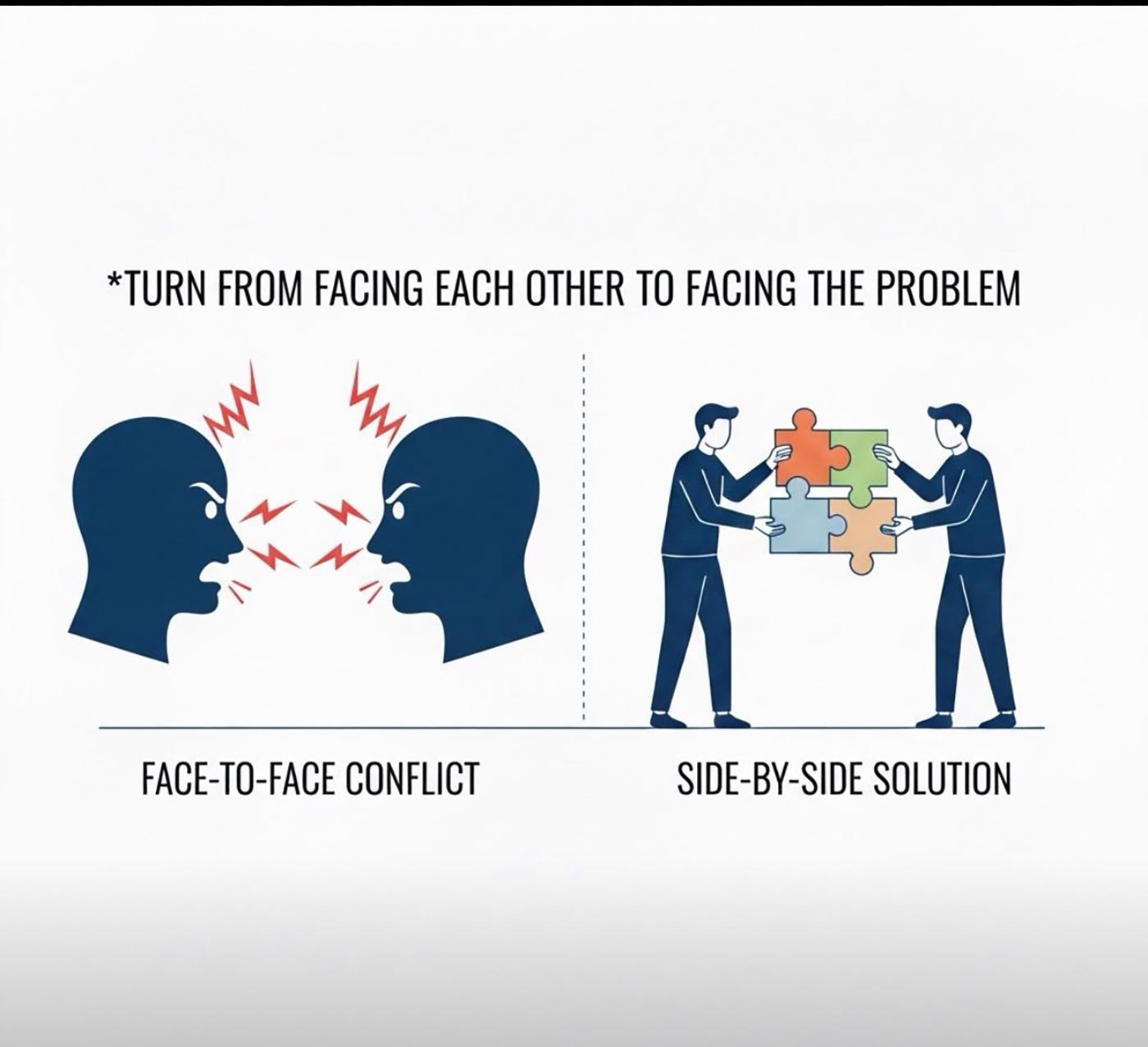

Turn from facing each other to facing the problem. It sounds simple. But it changes everything.
I have been reading Getting to Yes by Roger Fisher and William Ury, a classic text on principled negotiation that has shaped how lawyers, mediators, diplomats, and business leaders approach conflict for decades. It is the kind of book that makes you pause, put it down, and think.
One idea in particular stopped me: the call to turn from facing each other to facing the problem together. It is a deceptively simple reframe, but in practice, it is one of the most transformative shifts available in any difficult conversation, whether across a mediation table, in a boardroom, or at home.
Why most conflicts stay stuck
Most disputes get stuck because the parties are focused on each other rather than on the problem they share. Each side is defending a position, protecting an ego, or trying to win a point. The conflict becomes a tug-of-war, with both parties pulling in opposite directions and the problem sitting untouched in the middle.
In this dynamic, every concession feels like a loss. Every compromise feels like defeat. So both parties dig in, the dispute escalates, costs mount, and the relationship deteriorates further with every exchange.
The shift: from confrontation to collaboration
When both parties turn to face the problem, rather than each other, the entire dynamic changes. The problem becomes the shared adversary. Both sides are now, in a meaningful sense, on the same team. Solutions stop being something one party wins at the other’s expense, and start becoming something both parties build together.
This is the foundation of principled negotiation, and it is what makes mediation so effective when it is done well. A skilled mediator does not pick a side. They redirect attention away from the conflict between the parties and towards the problem that needs a solution.
It applies everywhere
What struck me most about this idea is how universal it is. I was once given advice before getting married: you are on the same team, face the problem together, not each other. It is the same principle, in a completely different context. And it works just as well.
Whether the conversation is happening at home, in the workplace, across a debt negotiation, or in a formal mediation, the same truth applies: there does not need to be a winner and a loser. There only needs to be a solution.
In commercial disputes, this mindset shift has practical consequences. Parties who approach negotiation collaboratively tend to reach settlements faster, at lower cost, and with their relationships intact.
If you work in business, manage teams, deal with clients, or simply want to handle difficult conversations better, Getting to Yes by Fisher and Ury is worth your time.
The best negotiators are not the most aggressive. They are the ones who understand that the goal is not to beat the other side. It is to solve the problem. And that starts with turning to face it together.
Need help navigating a difficult negotiation or dispute? We assist businesses and individuals in finding collaborative, cost-effective solutions to commercial disputes.
This article is for information purposes only and does not constitute legal advice.


0 Comments